Two Thai fishermen convicted of raping and murdering, Katherine Horton, a 21-year-old British student on holiday in Thailand, on New Year's Day have had their death sentences commuted to life imprisonment, their lawyer said today, 25th November.
Bualoy Kothisit, 23, and Wichai Sonkhaoyai, 24, were sentenced to death after a speedy trial in January but won a reprieve this month after an appeal. The trial was strongly criticised after Mr. Thaksin Shinawatra, Prime Minister at the time, called for the harshest punishment. The mother of the victim rejected the death penalty saying that such would also be the wish of her daughter.
"The court commuted their death sentences on the ground that they had voluntarily confessed their crime,'' lawyer Prompatchara Namuang said, adding that prosecutors could challenge the court's decision and bring the case to the Supreme Court by December 7.
Saturday, November 25, 2006


Wednesday, November 22, 2006
The Last Executioner
 The Last Executioner Memoirs of Thailand's Last Prison Executioner by Chavoret Jaruboon
This is a distasteful book. It is a book of no literary merit, little imagination, and little of human feeling. But it tells the story in plain, unadorned language of the most distasteful job on this earth, that of a public executioner. It is an unacceptable job, no one should be called on to carry out judicial murder and made to believe that it is their duty to do so. The task of execution highlights the whole repugnance of the death penalty and the gradual realisation of this is leading to its ultimate abolition.
Chavoret Jaruboon was an ordinary young man who sought the prison service as a stable employment. He was assigned to Bang Kwang, the high security prison in Bangkok where male prisoners condemned to death are detained and where executions are carried out. Others would have kept well away from the death chamber and its rituals but Chavoret wandered in when the machine gun was being serviced and was instructed in its operation by one of the executioners. He must well have realised where his interest would lead. He was recommended to join the team of executioners and progressed through the various levels of responsibility until after ten years he became executioner.
Chavoret's motivation for taking the steps which led to his position are never clearly stated. He obviously has the careful technical ability required to operate a weapon that can give problems, an ability which would not otherwise lead to promotion in the prison service. He is a meticulous person with great control of his feelings and an unquestioning respect for authority, the qualities which certainly led to his selection as executioner. He does not glory in the comradeship of the prison staff but enjoys the regard of his superiors, the chance to perform before the highest authorities, and to make an impression. The 2000 baht fee earned for an execution helps towards the education of his children.
His mental rationalization of his function is a simple one. There are people who are pure evil, "I believe that there are truly bad people who can never be cured of their desire to do depraved things... I believe this type of person deserves to die". Deliberately, he refuses to know the story of the criminals to be executed until after their death lest any personal feeling might affect his efficiency. His duty is to carry out the execution efficiently. Regulations must be complied with but for the rest there must be no delay or mishap which would prolong the agony of prisoner or other participant. Early in the book he repeats his simple belief that the death sentence is justified, and justifies his participation in carrying it out.
It is only at the end of the book that he admits that "killing criminals troubled and depressed me". He has come a long way, "I have come to believe that severe punishment does nothing to solve the problem of crime but it should function as an extreme warning" without seeing the contradiction in this sentence. He reflects further "I believe in karma, which can be bad or good depending on the individual. I never got any pleasure out of shooting people, or out of performing any other role in the persecution process. It was my job". Buddhism gives him the excuse "the convicts on death row are swamped in bad karma and the executioner is doing them a favour by sending them on to their next incarnation for the chance to redeem themselves". It is to his credit that this opinion is quoted from Buddhist monks and he does not adopt it as his own.
Executing 55 men and women in a working life is an abomination. The memoirs of Chavoret Jaruboon are a sad and distasteful story. In the end he cannot justify his choice in life because there is no justification. The value of his story is surely to instruct those who form the chain of command in the justice system that their adherence to capital punishment is also their karma as much as if they pulled the trigger of the machine gun. And so for all of us who acquiesce to this perversity of justice without declaiming 'Not in my name'
'The End of the Death Penalty' refers like the title of the book 'The Last Executioner' to the end of the death penalty by machine gun. Since 2003 Thailand has replaced the machine gun by lethal injection. There are now three executioners where one sufficed before, and the process is no less horrible.
'The End of the Death Penaly' looks forward in hope to the day when this awful practice will truly end.
'The Last Executioner' is available in Asia Book Store
Sunday, November 12, 2006
Conditions of Detention On Bang Kwang Death Row
 Prisoners are shackled permanently, shackle chains weigh about 5 kgs
There are up to 30 prisoners in each cell, they sleep on the floor in rows
Prisoners spend up to 22.5 hours a day in crowded cells
Ventilation is through a single narrow window which also provides the only lighting
Living in semi-darkness the eyesight of prisoners is affected
Apart from being shackled there is no space to exercise
Drinking water is stale and contaminated
From testimony of prisoners
Wednesday, November 08, 2006
Justice Minister who refused to sign death sentences
 When Seiken Sugiura was appointed Japanese Minister of Justice last October, he declared his intention of not signing execution orders while in office. He based his decision on Buddhist religious beliefs and philosophy. When reprimanded by the Prime Minister he said that his remarks only described his personal feeling and did not refer to official duties. On Tuesday next he will step down as Justice Minister when Prime Minister Junchiro Koizumi retires.
During his year in office Suguira has refused to sign execution orders. He has received both praise and blame for his action.
Surely the act of signing is an act of responsibility, expressed as much in a refusal to sign as it would be in signing.
One legal expert gave support: “The law may expect a Justice Minister to exercise leadership in such decisions, depending on the trends of the times”.
Another commentator claimed that a refusal to sign was a failure to fulfil the duty of Justice Minister.
Tuesday, October 31, 2006
China Changes Law on Death Penalty
A Lesson for Thailand
On 31st October China adjusted its law on capital punishment to reduce judicial errors.
The new measures, which will become effective on 1st January, legislate that all death sentences passed by local courts will be reviewed and ratified by the Supreme Court.
The present system of allowing provincial High Courts to sign orders of execution was instituted in 1983 and resulted in a series of judicial errors. The President of the Supreme Court, Xiao Yang, believes that the change in law is an important stage in avoiding judicial error.
In addition certain courts will allow oral presentations of appeals to replace a review of documents only. This measure is an important indicator for Thailand where obligatory review of death sentences are by review of documentation only without the possibility of oral clarification, thereby limiting the effectiveness of the appeals to reverse errors of judgment.
On 31st October China adjusted its law on capital punishment to reduce judicial errors.
The new measures, which will become effective on 1st January, legislate that all death sentences passed by local courts will be reviewed and ratified by the Supreme Court.
The present system of allowing provincial High Courts to sign orders of execution was instituted in 1983 and resulted in a series of judicial errors. The President of the Supreme Court, Xiao Yang, believes that the change in law is an important stage in avoiding judicial error.
In addition certain courts will allow oral presentations of appeals to replace a review of documents only. This measure is an important indicator for Thailand where obligatory review of death sentences are by review of documentation only without the possibility of oral clarification, thereby limiting the effectiveness of the appeals to reverse errors of judgment.
Monday, October 23, 2006
Department of Justice to Discuss Death Penalty
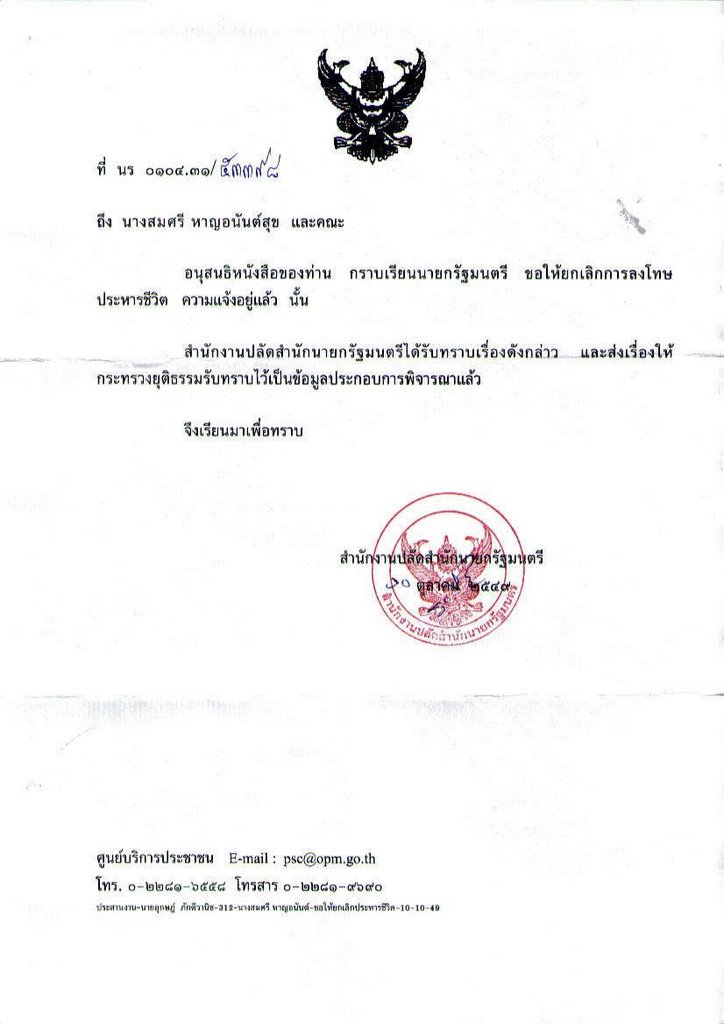 In a response to a submission on World Action against the Death Penalty, 10th October, by the Thai Coalition Against the Death Penalty, to the Prime Minister's Office and to the Correction' s Department, a response has been received with the assurance that the submission has been forwarded to the Department of Justice for discussion.
Monday, October 16, 2006
Abolition of Death Penalty - Thongbai Thongpao
 In listing tasks worthy of attention for the new interim Minister of Justice, Mr. Charnchai Likhitjittha, Thongbai Thongpao, renowned human rights lawyer, lists the following:
…..a lack of justice is the root cause of several major problems that call for immediate solutions today. In the war against drugs during the Thaksin administration, thousands were killed without trial despite complaints to the United Nations Human Rights Commission. The National Human Rights Commission had also submitted a report on the need for a probe into the issue to the Thaksin government, but no action was taken.
Therefore, it would be nice if the new minister reconsiders this issue and installs safeguards to prevent such extrajudicial killings from happening again.
A call for the abolition of capital punishment should also be considered now that more than half of all countries in the world have already lifted it.
I wholeheartedly support the policy to create justice without indiscrimination. For problems in the deep South, many are of the opinion that they are caused not by differences in races and religions or by separatists but rather by abuses of authority by officials and years of being treated unfairly. By restoring justice, peace will prevail in the region.
Friday, October 13, 2006
Death Penalty Thailand - The Final Say
In a response to statement issued on World Abolition Day by the Thai Coalition Against the Death Penalty (TCADP) a government spokesman said that the government must retain the death penalty as such was the wish of the majority of the population. The following letter is a reply from the Union for Civil Liberties:
POSTBAG Bangkok Post, 12th October 2006
Death penalty is an affront to humanity
The response of Thongthong Chandarangsu, justice deputy permanent secretary, to the submission of human rights activists that the death penalty be abolished raises a fundamental issue of ethics (Bangkok Post, Oct 11, "Rights advocates seek end to death penalty").
The momentous issue of judicial execution cannot be decided by majority vote, especially by a population which remains uninformed and where the issue has not been debated.
Arguments against the death penalty are based on the perception that the right to life is the most basic right of a human being and that no individual or government has the right to take it away. As the world came to understand that slavery and judicial torture are unacceptable infringements of human dignity, so, today, almost two-thirds of the world's nations have come to realise that the death penalty also is an affront to humanity.
The motive of moral conviction is supported by practical experience that the death penalty is no more effective a solution to crime than the punishment of life imprisonment. The abolition of the death penalty recognises the inalienable right to human life and founds a culture where lethal violence becomes abhorrent. The rights of victims are thereby more enhanced than by a vengeful satisfaction of an illusory blood debt.
Twenty-five years ago the death penalty was abolished in
The practice of waiting for majority approval in ethical issues would be a perverted notion of democracy and a failure of leadership.
It is timely that the worldwide trend to abolition is being broadcast in
DANTHONG BREEN
Chairman,
World Day for the Abolition of Death Penalty - Thailand
 ให้สังคมตัดสินเลิกโทษ"ประหารชีวิต"
เรียกร้อง-สมาคมสิทธิเสรีภาพของประชาชน ชุมนุมหน้าทำเนียบรัฐบาล และเข้ายื่นหนังสือผ่านไปถึง พล.อ.สุรยุทธ์ จุลานนท์ นายกรัฐมนตรี เรียกร้องให้ยกเลิกโทษประหารชีวิต เมื่อวันที่ 10 ตุลาคม
นายธงทอง จันทรางศุ รองปลัดกระทรวงยุติธรรม โฆษกกระทรวงยุติธรรม กล่าวถึงกรณีองค์การนิรโทษกรรมสากลยื่นหนังสือเรียกร้องให้ยกเลิกโทษประหารชีวิต เนื่องในโอกาสวันนิรโทษกรรมสากลว่า คงไม่มีสูตรสำเร็จว่าควรหรือไม่ควรประหารชีวิตสำหรับทุกประเทศ แต่ละประเทศมีภูมิหลังและวิวัฒนาการที่แตกต่างกัน การเรียกร้องให้ยกเลิกในวาระสำคัญทำได้ แต่ต้องสร้างความรู้ความเข้าใจกับประชาชนให้เห็นคุณเห็นโทษทั้ง 2 แง่มุม สุดท้ายแล้วให้ข้อมูลให้ประชาชนคนในประเทศตัดสินใจ รัฐบาลปัจจุบันมีเวลา 1 ปีเท่านั้น เรื่องนี้จึงไม่แน่ใจว่าจะได้รับการพิจารณาในเร็ววันนี้หรือไม่ เพราะต้องฟังความเห็นประชาชนเป็นสำคัญ แต่ในภาคปฏิบัติแล้ว ผู้ต้องขังยังมีสิทธิได้รับการลดโทษในวาระโอกาสสำคัญ จากประหารชีวิตเป็นจำคุกตลอดชีวิต
Tuesday, October 10, 2006
World Day for the Abolition of the Death Penalty - Thailand
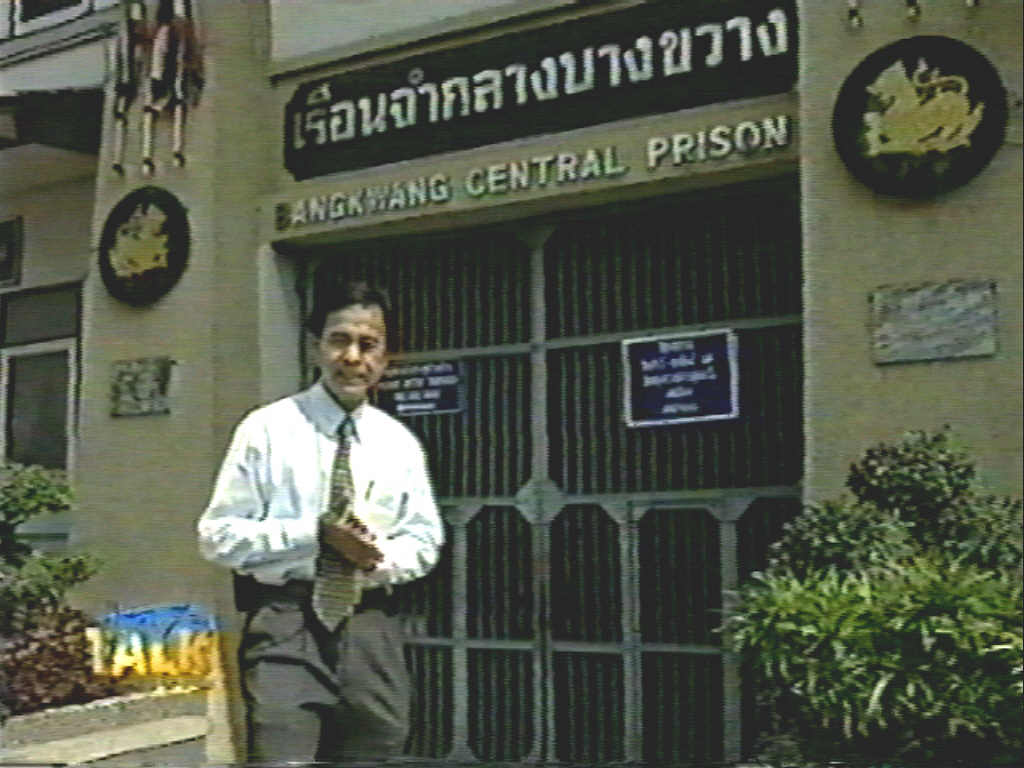 The first activity marking World Day for the Abolition of the Death Penalty in Thailand took place on October 10th. There were many adverse conditions, Thailand is still under martial law and prison authorities could insist threatningly that the gathering was illegal, and on no account would they allow it to take place or be photographed in front of the entrance to the prison. Besides, it was raining continually and the road and sorroundings were flooded! The result was a rather restricted showing of shackling chains, the display of a banner calling for abolition, the distribution of literature on the death penalty, and of copies of the statement printed below. The only part of the planned protest which could be carried out in full was the delivery of the statement and literature on the death penalty to the Governor of the Corrections Department.
To supplement the curtailed activity, the statement and literature were also presented at the Prime Minister's Parliamentary Office.
No More Death Penalty, No More Shackling
On the fourth World Day for the Abolition of the Death Penalty, the Thai Coalition against the Death Penalty (TCADP) is joining the international community to review again the traditional actions on heinous offences, which have been in practice by all former governments in Thai history. The Death Penalty is seen as a dark sign of all societies including
In the light of humanity and respect for human rights, we are also concerned about the condition of prisoners who are condemned to death, all of whom are shackled on the legs for twenty four hours a day. The Correction Department previously informed us that such practice will be reviewed and that they are willing to learn from the practices of many countries where shackling is not used. However until now this promise, has not been carried beyond the level of words. We have been asked by the international community and the prisoners themselves to campaign to abolish shackling, which is considered a part of torture or double punishment.
On the occasion of World Day for the Abolition of the Death Penalty, TCADP invites the Thai government and Correction Department, as well as Thai people to respond to the good will and similar activities in sixty countries worldwide to abolish the death penalty and shackling.
"No More Death Penalty, No More Shackling" is in line with moral principles. It is time for all Buddhists and others of different religious in
In submitting these proposals we also convey our appreciation of the difficult task of prison administration and hope that
Thai Coalition Against the Death Penalty
จดหมายเปิดผนึก
วันที่ ๑๐ ตุลาคม ๒๕๔๙
เรื่อง การยกเลิกโทษประหารชีวิต
กราบเรียน ฯพณฯ ท่านนายกรัฐมนตรี พล.อ.สุรยุทธ์ จุฬานนท์
บนพื้นฐานของมนุษยธรรมและการเคารพซึ่งสิทธิมนุษยชน กลุ่มประสานงานฯยังห่วงใยในประเด็นการตีตรวนนักโทษกลุ่มที่ทำผิดร้ายแรงนี้ทึ่ถูกตีตรวนขาทั้งสองข้างเป็นเวลา ๒๔ ชั่วโมงและทุกวัน ก่อนหน้านี้ทางกรมราชทัณฑ์เคยกล่าวว่าจะมีการทบทวนการกระทำดังกล่าวโดยยินดีที่จะเรียนรู้จากประเทศอื่นๆว่าจะทำอย่างไรเมื่อได้ยกเลิกการตีตรวนไปแล้ว ขณะนี้กลุ่มประสานงานฯเห็นว่าการสัญญาดังกล่าวยังเป็นเพียงคำพูดเท่านั้น ไม่มีความคืบหน้าให้เห็นเป็นที่ประจักษ์ จนทำให้นานาชาติ และนักโทษที่ถูกตีตรวนเองได้ร้องขอให้ยกเลิกการปฏิบัติเช่นนี้โดยเร็ว เพราะถือว่าเป็นการกระทำที่ไม่ต่างจากการทรมานหรือการลงโทษสองชั้นนั่นเอง
กลุ่มประสานงานฯขอยื่นข้อเสนอนี้ พร้อมกับขอแสดงความชื่นชมที่เจ้าหน้าที่ที่เกี่ยวข้องทุกท่านซึ่งทำงานด้วยความยากลำบาก และหวังว่าประเทศไทยจะสามารถเดินไปถึงจุดมุ่งหมายให้มีการปฏิรูปในเรื่องนี้ โดยเฉพาะเป็นการทำเพื่อผู้ด้อยโอกาสและผู้ที่จะถูกปลิดชีวิตจากโทษประหารชีวิต
กลุ่มประสานงานรณรงค์ยุติโทษประหารชีวิต
สมาคมสิทธิเสรีภาพของประชาชน(สสส.)
องค์การนิรโทษกรรมสากล ประเทศไทย
Asian Institute for Human Rights (AIHR)
Asian Human Rights Commission (AHRC)
Law Council of
Cross Cultural Foundation
Thai Coalition for Human Rights Defender
Subscribe to:
Posts (Atom)