Thursday, December 28, 2006

Abolition in French Constitution

On 3rd January President Jacques Chirac of France vowed to forbid the death penalty absolutely and in all circumstances. Now approaching the end of his presidency he is keeping his promise. A change in the French Constitution is being proposed to the Council of State in January, in the words: NO ONE CAN BE CONDEMNED TO DEATH

France already abolished the death penalty 25 years ago, now it does so irreversibly. In the words of a spokesperson of Amnesty International France; "In enacting a constitutional prohibition on the death penalty, France is sending a strong message to all governments maintaining this cruel, inhuman, and degrading punishment".

However, France could make a further step by acceding to the Second Optional Protocol of the Covenant on Social and Political Rights which would confirm its commitment to the community of nations.

South Africa, Ireland, and Germany already prohibit the death penalty in their Constitutions AND have signed the Second Protocol.

Thailand is at present drafting a new Constitution . . . . . . . .

Monday, December 25, 2006

Black Day for Japan and for the World

On Christmas Day 2006 Japan hanged four men. While Christmas Day is considered world wide as a day of peace,Japan wished to show its people and the world that the death penalty remains in force in Japan. The last previous execution took place a few days before the appointment as Justice Minister of Seikei Sugiura in 2005 who, following his Buddhist beliefs, refused to sign death warrants for executions (see posting below). As a result Japan has not had an execution for a period of fifteen months.

When the term of prime minister Junichiro Koizumi ended, Seikei Sugiura also stood down to be replaced by a Minister in favour of the death penalty. Japan is the only major industrialised country besides the United States maintaining Capital Punishment. Executions are carried out without the knowledge of relatives of the condemned, and in unknown locations. The condemned prisoners themselves are informed at the last moment. These practices are against United Nations declared norms for the humane treatment of persons condemned to death.

The Christmas Day executions are particularly noxious as two of those executed are aged 77 and 75 years old. The other two are 64 and 44 years old.

Saturday, December 16, 2006

New Death Penalty Lesson for Thailand

In his autobiography “The Last Executioner” Chavoret Jaruboon describes steps leading to Thailand’s adoption of execution by lethal injection: “Some prisons in America started using lethal injection back in 1977. Bang Kwang wanted to move with the times. Our forward-thinking chief sent researchers over to America to study the process of injecting a criminal with chemicals”

The time has come when researchers should return to study the suspension of executions by lethal injection in the US as it is increasingly realised that lethal injection causes unacceptable suffering. The latest in a series of reactions came on Friday 15th December when Judge Jeremy Fogel in California ruled that executions by lethal injection as practiced in California do not conform to the US Constitution which forbids cruel and unusual punishment.

Lethal injection involves the introduction of three chemicals into the veins of the condemned prisoner. The first is a sedative inducing unconsciousness, the second paralyses the muscles and the third causes the heart to stop. If the sedative does not act correctly the two following chemicals cause extreme pain. Several other US states are encountering the same difficulty. On Wednesday last a condemned person being executed in Florida took 34 minutes to die. The governor of Florida, Jeb Bush has ordered a suspension of executions and the creation of a commission of inquiry on the process.

Executions in California have been suspended since February last.

In fact there is no solution to the problems of execution. The proposal that a medical doctor participate in executions to confirm that the sedative has succeeded is rejected by the medical profession.

The medical profession in Thailand has long since issued a statement that doctors or nurses are unwilling to participate in executions (see posting below, Statement of Thai Medical Personnel).

The Union for Civil Liberties proposes that Thailand delay no longer in joining the majority of the world’s countries in abandoning forever the barbaric practice of the death penalty. The writing of a new constitution is an opportune time to take this momentous step in protecting the right to life in Thailand.

Saturday, November 25, 2006

Murder on Koh Samui, death sentence commuted

Two Thai fishermen convicted of raping and murdering, Katherine Horton, a 21-year-old British student on holiday in Thailand, on New Year's Day have had their death sentences commuted to life imprisonment, their lawyer said today, 25th November.

Bualoy Kothisit, 23, and Wichai Sonkhaoyai, 24, were sentenced to death after a speedy trial in January but won a reprieve this month after an appeal. The trial was strongly criticised after Mr. Thaksin Shinawatra, Prime Minister at the time, called for the harshest punishment. The mother of the victim rejected the death penalty saying that such would also be the wish of her daughter.

"The court commuted their death sentences on the ground that they had voluntarily confessed their crime,'' lawyer Prompatchara Namuang said, adding that prosecutors could challenge the court's decision and bring the case to the Supreme Court by December 7.


Wednesday, November 22, 2006

The Last Executioner

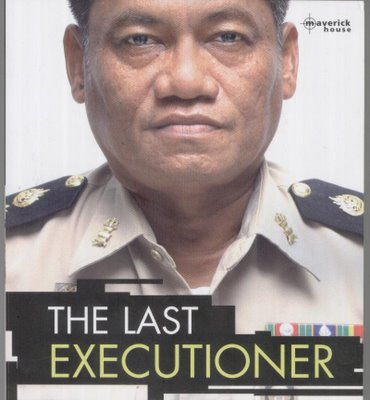
The Last Executioner Memoirs of Thailand's Last Prison Executioner by Chavoret Jaruboon

This is a distasteful book. It is a book of no literary merit, little imagination, and little of human feeling. But it tells the story in plain, unadorned language of the most distasteful job on this earth, that of a public executioner. It is an unacceptable job, no one should be called on to carry out judicial murder and made to believe that it is their duty to do so. The task of execution highlights the whole repugnance of the death penalty and the gradual realisation of this is leading to its ultimate abolition.
Chavoret Jaruboon was an ordinary young man who sought the prison service as a stable employment. He was assigned to Bang Kwang, the high security prison in Bangkok where male prisoners condemned to death are detained and where executions are carried out. Others would have kept well away from the death chamber and its rituals but Chavoret wandered in when the machine gun was being serviced and was instructed in its operation by one of the executioners. He must well have realised where his interest would lead. He was recommended to join the team of executioners and progressed through the various levels of responsibility until after ten years he became executioner.
Chavoret's motivation for taking the steps which led to his position are never clearly stated. He obviously has the careful technical ability required to operate a weapon that can give problems, an ability which would not otherwise lead to promotion in the prison service. He is a meticulous person with great control of his feelings and an unquestioning respect for authority, the qualities which certainly led to his selection as executioner. He does not glory in the comradeship of the prison staff but enjoys the regard of his superiors, the chance to perform before the highest authorities, and to make an impression. The 2000 baht fee earned for an execution helps towards the education of his children.
His mental rationalization of his function is a simple one. There are people who are pure evil, "I believe that there are truly bad people who can never be cured of their desire to do depraved things... I believe this type of person deserves to die". Deliberately, he refuses to know the story of the criminals to be executed until after their death lest any personal feeling might affect his efficiency. His duty is to carry out the execution efficiently. Regulations must be complied with but for the rest there must be no delay or mishap which would prolong the agony of prisoner or other participant. Early in the book he repeats his simple belief that the death sentence is justified, and justifies his participation in carrying it out.
It is only at the end of the book that he admits that "killing criminals troubled and depressed me". He has come a long way, "I have come to believe that severe punishment does nothing to solve the problem of crime but it should function as an extreme warning" without seeing the contradiction in this sentence. He reflects further "I believe in karma, which can be bad or good depending on the individual. I never got any pleasure out of shooting people, or out of performing any other role in the persecution process. It was my job". Buddhism gives him the excuse "the convicts on death row are swamped in bad karma and the executioner is doing them a favour by sending them on to their next incarnation for the chance to redeem themselves". It is to his credit that this opinion is quoted from Buddhist monks and he does not adopt it as his own.
Executing 55 men and women in a working life is an abomination. The memoirs of Chavoret Jaruboon are a sad and distasteful story. In the end he cannot justify his choice in life because there is no justification. The value of his story is surely to instruct those who form the chain of command in the justice system that their adherence to capital punishment is also their karma as much as if they pulled the trigger of the machine gun. And so for all of us who acquiesce to this perversity of justice without declaiming 'Not in my name'
'The End of the Death Penalty' refers like the title of the book 'The Last Executioner' to the end of the death penalty by machine gun. Since 2003 Thailand has replaced the machine gun by lethal injection. There are now three executioners where one sufficed before, and the process is no less horrible.
'The End of the Death Penaly' looks forward in hope to the day when this awful practice will truly end.
'The Last Executioner' is available in Asia Book Store

Sunday, November 12, 2006

Conditions of Detention On Bang Kwang Death Row

Prisoners are shackled permanently, shackle chains weigh about 5 kgs
There are up to 30 prisoners in each cell, they sleep on the floor in rows
Prisoners spend up to 22.5 hours a day in crowded cells
Ventilation is through a single narrow window which also provides the only lighting
Living in semi-darkness the eyesight of prisoners is affected
Apart from being shackled there is no space to exercise
Drinking water is stale and contaminated
From testimony of prisoners

Wednesday, November 08, 2006

Justice Minister who refused to sign death sentences

When Seiken Sugiura was appointed Japanese Minister of Justice last October, he declared his intention of not signing execution orders while in office. He based his decision on Buddhist religious beliefs and philosophy. When reprimanded by the Prime Minister he said that his remarks only described his personal feeling and did not refer to official duties. On Tuesday next he will step down as Justice Minister when Prime Minister Junchiro Koizumi retires.
During his year in office Suguira has refused to sign execution orders. He has received both praise and blame for his action.
Surely the act of signing is an act of responsibility, expressed as much in a refusal to sign as it would be in signing.
One legal expert gave support: “The law may expect a Justice Minister to exercise leadership in such decisions, depending on the trends of the times”.
Another commentator claimed that a refusal to sign was a failure to fulfil the duty of Justice Minister.

Tuesday, October 31, 2006

China Changes Law on Death Penalty

A Lesson for Thailand
On 31st October China adjusted its law on capital punishment to reduce judicial errors.
The new measures, which will become effective on 1st January, legislate that all death sentences passed by local courts will be reviewed and ratified by the Supreme Court.
The present system of allowing provincial High Courts to sign orders of execution was instituted in 1983 and resulted in a series of judicial errors. The President of the Supreme Court, Xiao Yang, believes that the change in law is an important stage in avoiding judicial error.
In addition certain courts will allow oral presentations of appeals to replace a review of documents only. This measure is an important indicator for Thailand where obligatory review of death sentences are by review of documentation only without the possibility of oral clarification, thereby limiting the effectiveness of the appeals to reverse errors of judgment.

Monday, October 23, 2006

Department of Justice to Discuss Death Penalty

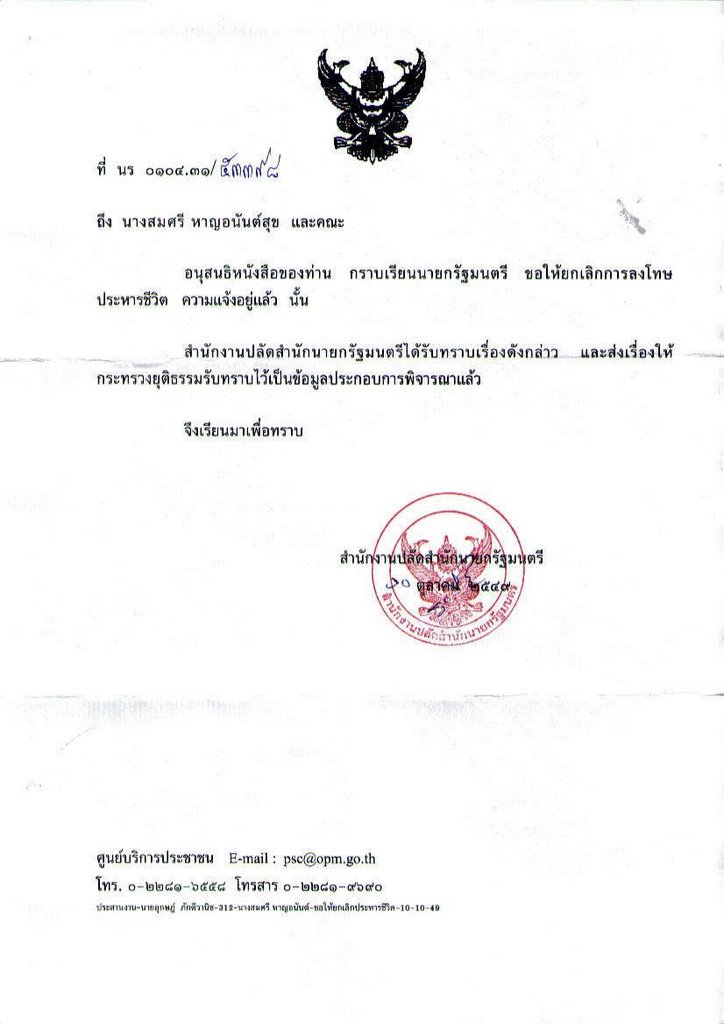
In a response to a submission on World Action against the Death Penalty, 10th October, by the Thai Coalition Against the Death Penalty, to the Prime Minister's Office and to the Correction' s Department, a response has been received with the assurance that the submission has been forwarded to the Department of Justice for discussion.

Monday, October 16, 2006

Abolition of Death Penalty - Thongbai Thongpao

In listing tasks worthy of attention for the new interim Minister of Justice, Mr. Charnchai Likhitjittha, Thongbai Thongpao, renowned human rights lawyer, lists the following:

…..a lack of justice is the root cause of several major problems that call for immediate solutions today. In the war against drugs during the Thaksin administration, thousands were killed without trial despite complaints to the United Nations Human Rights Commission. The National Human Rights Commission had also submitted a report on the need for a probe into the issue to the Thaksin government, but no action was taken.

Therefore, it would be nice if the new minister reconsiders this issue and installs safeguards to prevent such extrajudicial killings from happening again.

A call for the abolition of capital punishment should also be considered now that more than half of all countries in the world have already lifted it.

I wholeheartedly support the policy to create justice without indiscrimination. For problems in the deep South, many are of the opinion that they are caused not by differences in races and religions or by separatists but rather by abuses of authority by officials and years of being treated unfairly. By restoring justice, peace will prevail in the region.

Bangkok Post, 15th October 2006