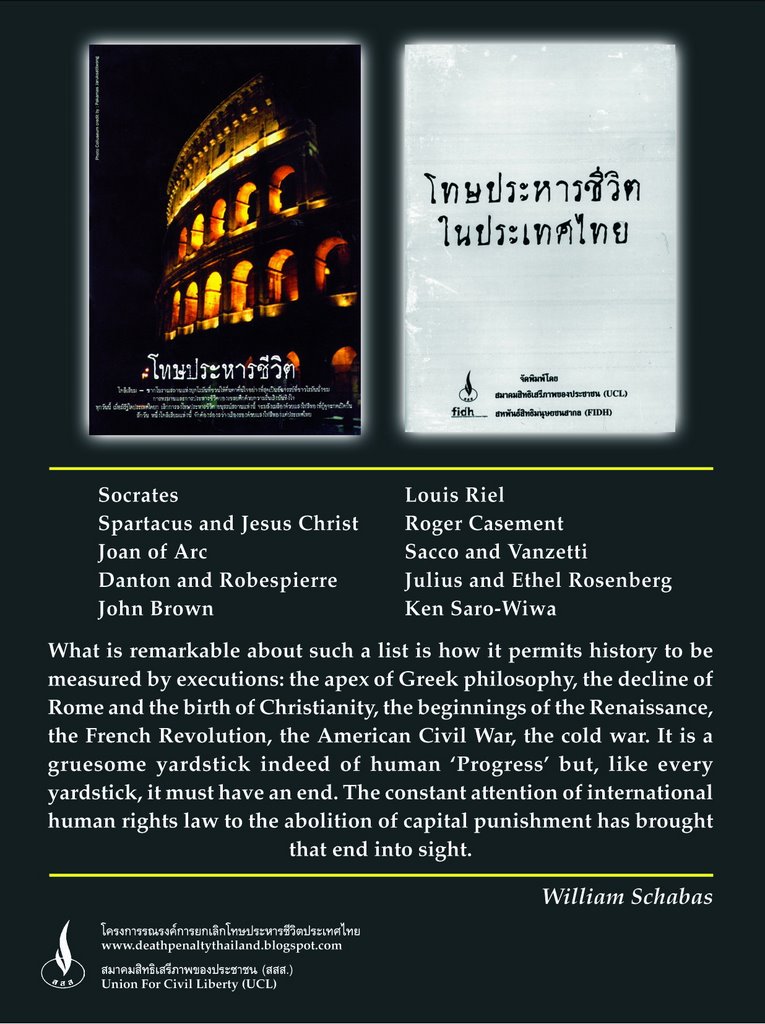
Poster distributed at National Seminar on Death Penalty, Bangkok July 2006
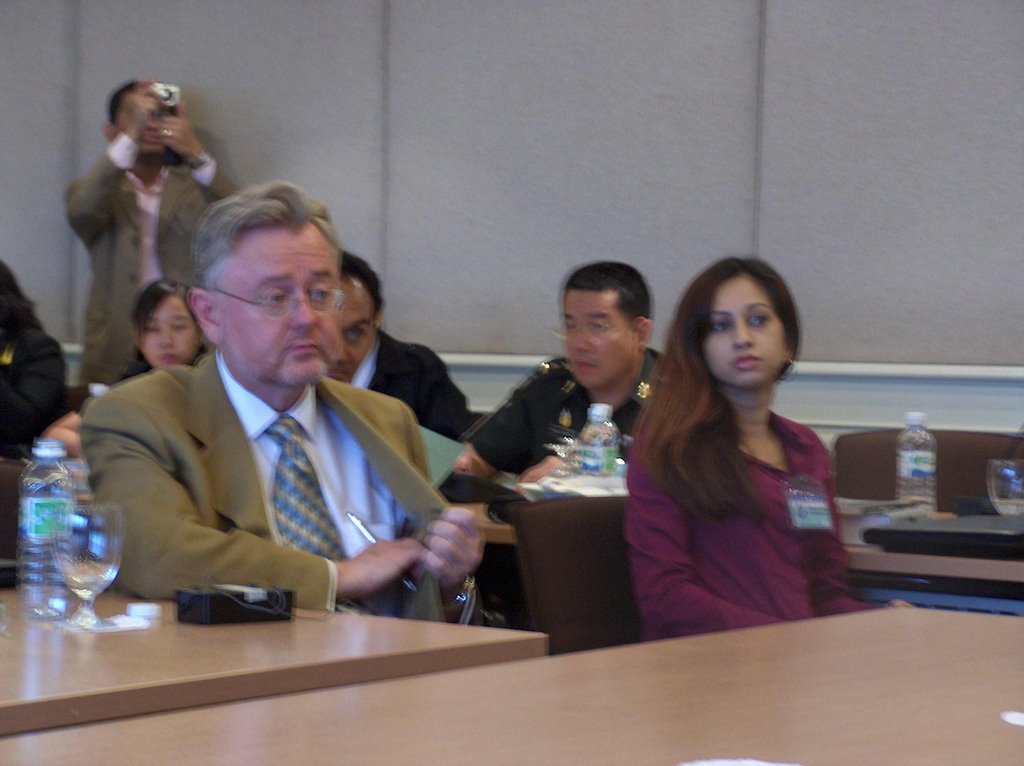 National Seminar on Capital Punishment in
 On 3rd and 4th July seminar on the death penalty was organized by the
The seminar covered a wide range of issues related to the death penalty in Thailand. A full report is being prepared for distribution and will be available on this site. In this preliminary news item some highlights of the meeting are indicated.
Key Note Speaker
The key speaker at the seminar was Professor William Schabas, a recognised world authority on the death penalty. On the first day he spoke of the inevitability that the death penalty will be abolished world wide, as have the institutions of slavery and judicial torture in the past. He based his assertion on the astonishingly rapid rate at which countries are declaring themselves in favour of abolition. Only a minority of countries persist in practicing the death penalty and they find themselves increasingly at a disadvantage in cooperation on criminal extradition with abolitionist countries. The most striking block of countries rejecting capital punishment are the countries of the Council of Europe and the European Union where rejection is a condition of membership. Professor Schabas has calculated that by comparing the number of retentionist countries with the rate of conversion to abolition, we can expect to see a world free of the death penalty in at most another 24 years. He pointed out that such an outcome was clearly in the minds of those who drafted the Universal Declaration of Human Rights who in Article 3 affirmed, without reservation, the right to life of all persons.
Professor Schabas enumerated the reasons in favour of the death penalty, the fear of wrongful conviction, the ineffectiveness of the death penalty in controlling crime, the victimisation in practice of the poor and disadvantaged who cannot afford expensive legal representation, and others. But he based his belief on the unacceptability of the death penalty, above all on the affront to human dignity which it implies.
On the second day of the seminar he laid out the principles of alternative punishment to the death penalty, which, simply stated, consists in life imprisonment. Life imprisonment can have different meanings allowing for parole or excluding it, but he declared himself ready to accept any preliminary meaning of the term in return for the willingness of governments to move towards abolition. The question of the meaning and practice of life imprisonment can be evolved over time. The practice in some states of interpreting life imprisonment as extending to the natural death of the condemned leads to a meaningless geriatric detention of people no longer capable of offending or even realising where they are and why they are there!
Philippine Experience
Another highlight of the seminar was a session on the recent Philippine experience of abolition. Speakers included His Excellency Antonio Rodriguez, the Philippine Ambassador to
Viewpoint of Political Parties
A presentation by representatives of three main political parties was illustrative of the general lack of appreciation in
Case Studies
The second day of the Seminar began with the presentation of case studies describing the legal procedures of several prisoners whose sentence of capital punishment remained after all stages of court hearing were exhausted. The cases were of accused whose poverty made them dependent on legal aid. The most striking aspect was that after the passing of death sentence by the court of first instance, their legal submissions to the Appeals and Supreme Courts were prepared not by a lawyer but by a fellow prisoner supposedly skilled in such matters. The lack of professional participation in what should have been the most important part of the legal process is chilling.
Prison Conditions
In the final session Dr. Waemahadee Waedao, member of the Senate, discussed prison conditions in the light of his own recent imprisonment in the South of Thailand. He discussed the general conditions of his imprisonment which were in direct conflict with the rights of a prisoner who had not been sentenced. He cited details of clothing, food, and medical care, as well overcrowding in the prison which grossly contravened his rights. He did not appear to be reassured by an assertion by a representative of the Corrections department that much was being done to improve the situation. Other speakers condemned as unacceptable the current practice of perpetual shackling of all male death row prisoners.
Conclusion
The above are brief indications of striking issues discussed during the Seminar. The content of other talks and sessions, and of points raised by the audience are also of great interest and will be made available in book form.
We appeal for clemency in the following case and urge readers to email this item to their local Indonesian representative as a gesture of appeal.
Boonyong Kaosa-art is among 16 people, including 10 foreigners, on death row for drug trafficking. Seven of the convicted are Nigerians, one is Nepalese and one is from
Ms Boonyong, 48, was arrested in 2002 at the airport in
The courts passed the death sentence in 2003 and the Thai government appealed for a reduced penalty in 2004.
 International Federation for Human Rights (FIDH)
 สัมนาระดับชาติ เรื่อง การลงโทษประหารชีวิตในประเทศไทย
คณะกรรมการสิทธิมนุษยชนแห่งชาติ และสมาคมสิทธิเสรีภาพของประชาชน(สสส.)
ณ ห้องประชุม ๕๐๑ สำนักงานคณะกรรมการสิทธิมนุษยชนแห่งชาติ
 Abolition of Death Penalty in Philippines, an Example for Thailand
Danthong Breen
Danthong Breen is president of the Union for Civil Liberty
Special to The Nation, Saturday 17th June
 IRAN. NAZANIN DEATH PENALTY OVERTURNED, NEW TRIAL TO BE HELD May 31, 2006: the Iranian Supreme Court ordered a new trial for Nazanin, overturning the death sentence handed down to her for having killed her attempted rapist, the 'Sharq' daily reported. Nazanin, who has been imprisoned for over a year, was sentenced to hang in January this year. She claimed self defence during her trial after she stabbed a man to death in March 2005. Nazanin, who was 17 at the time, had been out with her niece and their boyfriends on a road west of Tehran when two men started harassing them and then tried to rape them after the boyfriends had run away. "I committed murder to defend myself and my niece, ...
LETHAL INJECTION: Inmate on Gurney Tells Guards "It's not working."
On May 2, 2006, the execution of Joseph Clark in Ohio was delayed 90 minutes because the execution team was unable to find a suitable vein to deliver the lethal chemicals. After the team tried repeatedly to find a vein, Clark called out, "It's not working, it's not working." The guards closed the curtains to block witnesses from viewing the execution chamber. Witnesses then heard Clark moaning and groaning from behind the curtain. The curtain later reopened after the execution team managed to find a vein in Clark's left arm and he was put to death. Clark's execution proceeded despite the issuance of a stay based on a lethal injection challenge a few days earlier in another Ohio case by a federal court.
 Nation, 13th May 2006
 Time is ripe to abolish capital punishment in the Kingdom
This is a celebratory year for
It is not surprising that
But it wasn't that long ago that hundreds of crimes in England - even what are now petty ones, like stealing a loaf of bread - were capital offences. As protests were raised against this injustice, the idea of capital punishment meted out for many crimes became repellent. In a relatively brief period,
As Buddhists from all around the world gather in
Trirat Petchsingh
Nonthaburi
 The Nation: 7th May 2006
