Saturday, September 30, 2006

Thailand Still Shackles Death Row Prisoners

On 29th October 1996 Thailand acceded to the International Convention on Civil and Political Rights (ICCPR) thereby standing with the countries of the world binding themselves to observe just and civilised standards of behaviour. Ten years later Thailand continues to ignore and flagrantly offend these standards on many counts.

Article 7 of the Convention defines that “No one shall be subjected…to cruel, inhuman or degrading treatment or punishment.” Binding a human being in chains is cruel, inhuman and degrading treatment and yet its practice continues in Thai jails. This is especially the case in the case of male prisoners condemned to death who are shackled permanently. The shackles are welded in place on the legs of the prisoners and are removed only on the death or pardon of the prisoner.

Consider the reality of the practice. The chains can weigh as much as 5 or 6 kilograms, although a timely bribe may achieve a lighter load. The chain is permanently in place and prisoners must wear only the lightest clothing which can be passed through the small gap between flesh and metal to bath or change clothing. The metal scratches and tears the skin leading to ulceration and infection. Exercise. prescribed as a necessity of humane prison conditions, becomes impossible.

The first time in Thailand that I knew of chaining was on hearing the rhythmic clink of chains and without even looking, I realised what the sound meant, a chain gang walking at the edge of the road. I had thought that such a practice had gone with the disappearance of slavery and the reform of prison systems. That was over thirty years ago. Today you can see men in chains in the corridors of the Bangkok Criminal Court. Where is the presumption of innocence when a prisoner bound in chains appears before a court?

Fierce animals are chained, and even that is wrong. I have seen dogs, elephants, monkeys chained, and men. In all cases it is cruel, in the case of men it is inhuman and degrading. Once a prisoner, who had just arrived in Bang Kwang prison was shackled with chains still stained with the blood of a man who had been executed in the same chains a few hours before.

It is not that Thailand is unaware of its contravention of its obligations by the International Convention. The words of the Convention are written into Article 31 of the Constitution of 1997, disgracefully abrogated by the recent military coup; “..any kind of inhumane punishment is prohibited”. In a statement by the United Human Rights Committee in Geneva on 28th July 2005 Thailand was again reminded that the Committee “deplored the continued shackling of death row prisoners”. Furthermore, the Committee declared; “THE USE OF SHACKLING AND LONG PERIODS OF SOLITARY CONFINEMENT MUST BE STOPPED IMMEDIATELY”

When asked about the condemned continuation of shackling the Corrections Department recently replied that the prisons are NOT YET READY to fulfil Thailand’s obligations in this matter.

In condemning the practice of shackling UCL is not rejecting punishment. A condemned prisoner must be punished, but not in an inhuman manner. Over 60 years ago the UK attempted to shackle German prisoners of war on the excuse that Germany had shackled UK prisoners. Canada as a Commonwealth ally was expected to follow suit but replied with the firm principle that the contravention of the Geneva convention on the treatment of prisoners of war by one side of the conflict could never absolve those on the other side from observing their treaty obligations.

Thailand cannot be absolved from its obligations to observe humane norms which it has aqccepted as binding. Do the prisoners themselves object to their treatment. They cannot because Thailand has also neglected to sign the First Protocol of the Convention which gives its citizens right of appeal to the UN if their rights are transgressed. Thailand’s accession to the Convention remains an empty gesture both in theory and in practice.

Thursday, September 21, 2006

World Day Against the Death Penalty - Thailand

10th October is the 4th World Day against the Death Penalty with the theme "Death Penalty a Failure of Justice". The extent of the failure in Thailand has been revealed by a prisoner who was on death row in Bang Kwang prison in Bangkok for five years before having his sentence commuted to life imprisonment. Now released he recounted impressions gathered from his follow prisoners. He points out that among the prisoners on death row who see no prospect of release no lies are told about their past, they are people in a hopeless situation whose only relief is to share the truth of their stories with their companions.
From hearing the stories related over many years the released prisoner, now a practicing lawyer, estimates that:

* 12 to 13% of those condemned to death are innocent
* 30 to 40% of those condemned to death were indeed implicated in the crime for which they are condemned to death but not to a degree which should merit execution
* aprroximately 50% are indeed guilty as charged

DEATH PENALTY A FAILURE OF JUSTICE

For details of World Day see link to World Coalition

Saturday, September 16, 2006

Latest Statistics on Death Penalty in Thailand

DP Information on September 14th, 2006

Number of offences for all cases


Cases at Appeal Court

Cases at Supreme Court

Final Verdict

Total

Male

507

163

76

746

Female

84

3

15

102

TOTAL

591

166

91

848


Number of offences for drug cases


Cases at Appeal Court

Cases at Supreme Court

Final Verdict

Total

Male

269

95

73

437

Female

71

2

15

88

TOTAL

340

97

88

525

Number of offences for murder cases and others


Cases at Appeal Court

Cases at Supreme Court

Final Verdict

Total

Male

238

68

3

309

Female

13

1

-

14

TOTAL

251

69

3

323

Wednesday, September 13, 2006

Policy of Political Parties in Thailand on Death Penalty

ยกเลิกโทษประหารชีวิต กับความกล้าของพรรคการเมือง ?

6 กันยายน 2549 16:02 น.
พิทักษ์ เกิดหอม สมาคมสิทธิเสรีภาพของประชาชน (สสส.)

กรุงเทพธุรกิจออนไลน์ : อย่างน้อยมีพรรคการเมืองใหญ่สามพรรค ไทยรักไทย ประชาธิปัตย์ และชาติไทย ที่ไม่มีนโยบายในการยกเลิกโทษประหารชีวิต ไม่ว่าจะด้วยเหตุผลใดก็ตาม มันก็สะท้อนให้เห็นว่า เรื่องอะไรที่ไม่มีคะแนนเสียงหรืออาจจะเสียคะแนนเสียง ความใส่ใจของพรรคการเมืองแทบไม่มี โดยเฉพาะเรื่องที่เกี่ยวกับนักโทษ เพราะนักโทษต้องห้ามมิให้ใช้สิทธิเลือกตั้ง

การเสนอนโยบายเรื่องการยกเลิกโทษประหารชีวิต มิได้หมายความว่าเราจะปกป้องผู้กระทำความผิด ผู้กระทำความผิดที่ได้ผ่านมาต่อสู้คดีในชั้นศาลอย่างเต็มที่ ต้องถูกลงโทษเป็นเรื่องธรรมดาที่ต้องปฏิบัติ แต่ก็มีทางเลือกที่กระทำได้ภายหลังการยกเลิกโทษประหารชีวิตคือการจำคุกอย่างจริงจังในระยะเวลาที่ยาวนาน

เราอาจจะมองว่านักโทษที่ถูกประหารชีวิตในประเทศไทยมีน้อยเหลือเกินเมื่อเทียบกับสัดส่วนประชาชนในประเทศ ประเด็นเรื่องจำนวนนั้นไม่ใช่สาระสำคัญ แต่การคงโทษประหารชีวิตมันตอบไม่ได้ในหลักสิทธิมนุษยชนและหลักคำสอนของศาสนาพุทธ ในศีลข้อที่ 1 ห้ามฆ่าสัตว์ตัดชีวิต

การยกเลิกโทษประหารเท่ากับเป็นการประกาศทิศทางของประเทศไทย ที่จะไม่แก้ไขปัญหาด้วยวิธีการรุนแรงแบบเดิมๆ รัฐบาลและพรรคการเมืองในบางเรื่องบางประเด็น ควรเป็นผู้นำพาสังคมไปในทิศทางที่ถูกต้อง รัฐบาลและพรรคการเมืองควรชี้ให้ประชาชนเห็นว่า ต้นเหตุที่แท้จริงของอาชญากรรมฆ่าข่มขืนมาจากอะไร

แน่นอนทุกครั้งที่มีคดีข่มขืนและฆ่า สังคมมักโกรธแค้นชิงชังผู้กระทำความผิดและเรียกร้องให้ลงโทษอย่างรุนแรง แต่เราลืมไปว่าประเทศของเราในเวลานี้ มีแต่สื่อลามกและกระแสวัฒนธรรมกระตุ้นเล้าความกำหนัดอยู่ตลอดเวลา เหล้าเบียร์หาซื้อได้ง่ายเหมือนซื้อน้ำเปล่า เด็กและเยาวชนของเราจำนวนไม่น้อยที่ตกอยู่ในกระแสเหล่านี้ เมื่อสภาพแวดล้อมของสังคมเป็นอย่างนี้

เมื่อสังคมด้านมืดมันหล่อหลอมคนของเราให้กระทำความผิดได้ง่าย มันจึงไม่มีความชอบธรรมอันใดที่จะประหัตประหารชีวิตของเขา เว้นเสียแต่ว่าถ้าเราสามารถแก้ปัญหาโดยจัดสภาพแวดล้อมของสังคมให้ดี ไม่มีสิ่งกระตุ้นเร้า แต่มันยังมีการกระทำความผิดอีก นั่นย่อมหมายความว่าเป็นการกระทำความผิดโดยสันดานตนเองโดยแท้ รัฐอาจมีความชอบธรรมในการตัดออกจากสังคมเสียถึงแม้ผู้เขียนจะไม่เห็นด้วยก็ตาม

ประเด็นที่สำคัญยิ่งที่สัมพันธ์กับการลงโทษประหารชีวิต กระบวนการกลั่นกรองผู้กระทำความผิด โดยกระบวนการยุติธรรมทางอาญา ยังมีข้อจำกัดอยู่พอสมควร จากข้อมูลของกรมคุ้มครองสิทธิและเสรีภาพปรากฏว่าในปี 2548 มีจำเลยที่ยื่นแบบคำขอรับค่าทดแทนและค่าใช้จ่ายแก่จำเลยในคดีอาญาที่ศาลพิพากษาถึงที่สุดว่า จำเลยมิได้เป็นผู้กระทำความผิดหรือการกระทำของจำเลยไม่เป็นความผิด จำนวน 610 เรื่อง เข้าสู่การพิจารณาของคณะกรรมการจำนวน 355 เรื่อง

รัฐต้องจ่ายให้แก่จำเลยถึง 214 เรื่อง เป็นจำนวนเงินกว่า 60 ล้านบาท ในปี 2549 (มกราคม-กรกฎาคม) มีจำเลยยื่นแบบคำร้อง จำนวน 354 ราย รัฐต้องจ่ายจำนวนถึง 216 ราย เป็นจำนวนเงิน 58 ล้านบาท ข้อมูลเหล่านี้แสดงให้เราเห็นได้ว่า กระบวนการยุติธรรมทางอาญานับตั้งแต่ตำรวจ ทนายความ อัยการ และศาล ยังคงต้องปฏิรูปอีกพอสมควร

หากมีจำเลยคนหนึ่งคนใดที่อาจมิได้กระทำความผิด แต่ด้วยข้อจำกัดในกระบวนการยุติธรรมต้องถูกประหารชีวิต เรามิอาจเอาชีวิตเขากลับคืนมาได้ เช่นเดียวกับการบัญญัติกฎหมายของเรา เมื่อก่อนยาบ้ามีโทษสูงสุดไม่ถึงประหารชีวิต แต่ปัจจุบันโทษสูงสุดคือประหารชีวิต แต่หากวันใดสังคมหรือรัฐสภาเรียกร้องให้แก้ไขกฎหมายใหม่ กำหนดโทษไม่ถึงขั้นประหารชีวิตแล้วชีวิตคนที่เราประหารไปแล้วจะทำอย่างไร

ผมคิดว่าถึงเวลาแล้วที่พรรคการเมืองต้องตระหนักถึงการนำพาสังคมไทยไปในทิศทางที่ถูกต้องดีงาม ต้องกล้าหาญทางจริยธรรมมากพอสมควร โดยเฉพาะอย่างยิ่งภายใต้ภาวะวิกฤติทางการเมืองเฉกเช่นทุกวันนี้ มีความจำเป็นอย่างยิ่งยวดที่พรรคการเมือง นักการเมืองต้องกล้าฝ่ากระแสอารมณ์ความรู้สึก กล้าประกาศนโยบายยกเลิกโทษประหารชีวิต นั่นหมายความว่าเป็นการประกาศแนวทางสันติวิธีและเคารพศักดิ์ศรีความเป็นมนุษย์ในการบริหารประเทศ สังคมไทยจึงมีความหวังที่จะกลับมาสงบสุขอีกครั้ง

Sunday, September 03, 2006

Death Penalty in Indonesia

A serious debate on the death penalty has begun in Indonesia. Below are two views, one in favour of, the other in opposition to the death penalty.

AUGUST 25, 2006
INDONESIA: NU rejects abolition of death sentence
The Indonesian biggest Islamic organization, Nahdlatul Ulema (NU), has expressed disagreement to proposals to abolish the death sentence as the capital punishment would basically guarantee a more extensive life.
"In the philosophy of the law, there is no need to eliminate the death sentence, as capital punishment will protect human life in a broader sense," NU General Chairman KH Hasyim Muzadi said at his office here on Thursday.
And in fact, countries where the death sentence still prevails in their criminal code, had proven that crime, like murder, has declined, he said, taking Malaysia as a good example.
Hasyim Muzadi presented his opinion amidst rising demands for the abolition of the death sentence from some circles, on the grounds that capital punishment is a violation of human rights as it deprived of an individual`s right to live.
"But in this case, we should not only consider the human rights of a murderer. How about the rights of the the people they had killed, and why should we ignore their rights," Hasyim said.
As a matter of fact, the essence of a death sentence is to uphold justice, rather than the execution itself.
"For example, fights by using sickles are still rampant in Madura, because the killers knew they would be jailed for their crime for only a comple of years. Practically, such relatively short sentences have not deterred people from committing the same crime again, not to mention discrimination in the application of justice," he said.
Asked on the planned execution of Tibo and associates, and Amrozi, he said the government had the authority to consider and take a decision on who is liable to the death sentence through the legal process.
Touching on an appeal from from Pope Benedictus to the Indonesian government for a clemency to Tibo and friends in death row, Muzadi said that if it is based on humanitarism reasons, the appeal shoule be met for Amrozi and his associates. "I think the Vatican is aware of this."

Jakarta Post
Opinion, Patrick Guntensperger; the writer is a Jakarta-based political risk analyst
INDONESIA:Let's look at the death penalty
As the execution of the convicted Christian Poso terrorists draws near, predictably, groups of Christian bishops and other Christian are weighing in with their opposition to the death penalty. In a sense, this anti-judicial killing philosophical stance makes sense; it resonates well with the Jesus-inspired teachings and admonitions to love one's neighbor, to practice forgiveness, turn the other cheek, etc. I suppose one would have to be somewhat cynical to ask where these anti-death penalty activists were when executions of Islamic radicals were imminent.
Nevertheless, as Indonesia prepares to stand some more people in front of a wall and ritually and legally end their lives, this seems as good a time as any to consider the death penalty.
This is particularly treacherous territory to explore, because feelings run so high. For a fruitful dialogue on the subject, reason must be employed and personal feelings, no matter how intense, must be suppressed; few other discussions so quickly degenerate into ad hominem arguments.
I remember years ago, discussing the subject with my strongly pro-death penalty sister who, at the time, had 2 young children, while I had none. Disagreeing with my abolitionist stance, she shouted me down, arguing that I had no right to an opinion on the subject, being childless, but that I would quickly see her (correct) viewpoint if I ever had my own children to protect from those who would murder them.
Clearly the argument was going nowhere, so I suppressed 1 or 2 obvious retorts. In the first place, all of my philosophical education suggests that having a less personal stake (no children) in the matter under discussion rendered my viewpoint more, rather than less valid, being more objective.
Secondly, the assumption that having a legal death penalty in place protects children from predators simply doesn't hold water. There are no accepted statistical studies that support that widely held piece of dogma.
The most common argument in favor of the death penalty for murder is the deterrence argument. More specifically, deterrence falls into 2 different categories.
Let me be the first to concede the 1st of the 2, sometimes referred to as "specific deterrence". Specific deterrence argues, perfectly legitimately, that if a murderer is executed, that specific murderer is deterred from any repetition of the crime. That specific deterrence can be accomplished in any number of ways, we will leave for another discussion.
"General deterrence" on the other hand, can be summed up as the argument that suggests that members of a society are less likely to commit murder if they will be executed upon conviction of their crime. While on a superficial level that seems to make sense, as noted earlier, there is simply no evidence to support that hypothesis. And yet a completely unproven, some would even say utterly discredited hypothesis is the one upon which most arguments for the legal killing of human beings rests.
Studies have indicated that, more than the ultimate punishment, the deterrence that has any effect on those susceptible to deterrence is the likelihood of getting caught. That is to say, that when a criminal (of any sort, not just murderers) is making the Dostoevskyan calculus of crime versus punishment, the severity of the punishment is of far less significance than the estimated probability of detection. If a person is thinking of robbing a store, simply getting caught forms the largest part of the decision making process; whether he will do five years or seven probably doesn't even enter the equation.
In Indonesia where a drug smuggler may be executed, may spend twenty years in jail, or may be released after a few months, the severity of the potential penalty is disregarded in favor of planning the crime in such a way that detection is avoided, whatever the result upon conviction might be. The obvious effective deterrence is improving the law enforcement in the country, so that criminals have a reasonable expectation of being caught, and if, caught, convicted...no matter who they are.
Increasing the severity of the penalties, even expanding the use and frequency of the imposition of the death penalty, will have no effect whatever on lowering the murder or any other rate. There is some indication that, having nothing to lose, criminals may resort to murder to avoid apprehension; the murder rate may actually increase.
And that brings us to the most compelling reason even general deterrence, as a principle, doesn't stand up to scrutiny. The vast majority of homicides are not calculated at all. When a family member loses control and lashes out, when a street brawl erupts, when a demonstration gets out of control, the penalties for criminal behavior do not occur to those who are involved.
Certainly when a stoned, spoiled, rich kid pulls out a gun and shoots a waiter for a perceived slight, he has not worked out the cost-benefit ratio of instant gratification versus long term self-interest.
Interestingly, the reverse of this is also true in this climate of sectarian violence and terrorist attacks. Terrorist attacks, particularly suicide attacks, do make those sorts of calculations. The problem is that the calculations arrive at a solution that is satisfactory. The murderers, having judged whether to kill someone is worth their own death rationally decide that it is. In a perverse way, the death sentence in these instances legitimizes the terrorist murders, because it has tacitly agreed with the calculus.
What is needed is twofold. In the first place, those who break the law must have a reasonable expectation of apprehension. Convictions of those apprehended must be fair and even -handed. Secondly and most importantly, however, there needs to be a permeating sense of the sanctity of human life. All human life. And that can start by the people deciding that the state shouldn't take human life in an effort to prove that human life has intrinsic value.

Wednesday, July 12, 2006

Death Penalty Thailand - Poster


Poster distributed at National Seminar on Death Penalty, Bangkok July 2006

Friday, July 07, 2006

National Seminar on Capital Punishment in Thailand

National Seminar on Capital Punishment in Thailand

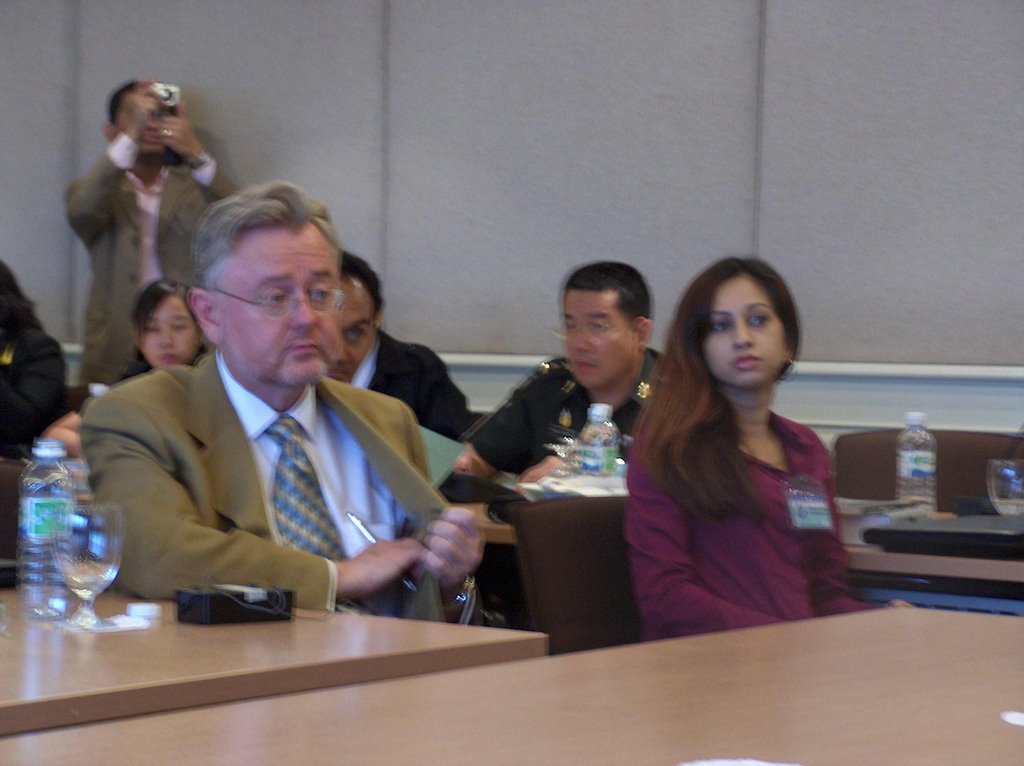
On 3rd and 4th July seminar on the death penalty was organized by the Union for Civil Liberty under the auspices of the National Human Rights Committee. Those attending were largely representatives of Government ministries with an interest in legal affairs, such as the Ministry of Justice, the Corrections Department, and the Ministry of Foreign Affairs. Diplomats, academics, students of human rights, and human rights activists also took part. The International Federation of Human Rights and Amnesty International were represented showing the importance given to the seminar on an international scale. A total of 115 persons registered their attendance.

The seminar covered a wide range of issues related to the death penalty in Thailand. A full report is being prepared for distribution and will be available on this site. In this preliminary news item some highlights of the meeting are indicated.

Key Note Speaker

The key speaker at the seminar was Professor William Schabas, a recognised world authority on the death penalty. On the first day he spoke of the inevitability that the death penalty will be abolished world wide, as have the institutions of slavery and judicial torture in the past. He based his assertion on the astonishingly rapid rate at which countries are declaring themselves in favour of abolition. Only a minority of countries persist in practicing the death penalty and they find themselves increasingly at a disadvantage in cooperation on criminal extradition with abolitionist countries. The most striking block of countries rejecting capital punishment are the countries of the Council of Europe and the European Union where rejection is a condition of membership. Professor Schabas has calculated that by comparing the number of retentionist countries with the rate of conversion to abolition, we can expect to see a world free of the death penalty in at most another 24 years. He pointed out that such an outcome was clearly in the minds of those who drafted the Universal Declaration of Human Rights who in Article 3 affirmed, without reservation, the right to life of all persons.
Professor Schabas enumerated the reasons in favour of the death penalty, the fear of wrongful conviction, the ineffectiveness of the death penalty in controlling crime, the victimisation in practice of the poor and disadvantaged who cannot afford expensive legal representation, and others. But he based his belief on the unacceptability of the death penalty, above all on the affront to human dignity which it implies.

On the second day of the seminar he laid out the principles of alternative punishment to the death penalty, which, simply stated, consists in life imprisonment. Life imprisonment can have different meanings allowing for parole or excluding it, but he declared himself ready to accept any preliminary meaning of the term in return for the willingness of governments to move towards abolition. The question of the meaning and practice of life imprisonment can be evolved over time. The practice in some states of interpreting life imprisonment as extending to the natural death of the condemned leads to a meaningless geriatric detention of people no longer capable of offending or even realising where they are and why they are there!

Philippine Experience

Another highlight of the seminar was a session on the recent Philippine experience of abolition. Speakers included His Excellency Antonio Rodriguez, the Philippine Ambassador to Thailand, and Attorney Theodore O. Te who had played a large part in fighting for abolition. The detail of the debate to abolish the death penalty, over a period of 12 years illustrated the complexity of issues involved. Lobbying had to be continuous and focused. An interesting aspect was the involvement of condemned prisoners themselves and their families, simple people who achieved a sophisticated level of appeal. Another aspect was the preparation and submission of case studies illustrating defects in death penalty legislation and practice. The example of the Philippines was frequently referred to throughout the seminar.

Viewpoint of Political Parties

A presentation by representatives of three main political parties was illustrative of the general lack of appreciation in Thailand for the world wide debate on abolition. The representatives agreed that a decision for abolition could be made at administrative government level without the need for changes to the Constitution. It was felt that time was needed for Thailand to adjust to the circumstances of abolition. The representative of one Party specifically claimed that the death penalty was necessary in Thailand for the defence of the revered institution of the Monarchy. A comment from the audience suggested that the UK, Norway, and Cambodia appeared capable of being both monarchies and abolitionist.

Case Studies

The second day of the Seminar began with the presentation of case studies describing the legal procedures of several prisoners whose sentence of capital punishment remained after all stages of court hearing were exhausted. The cases were of accused whose poverty made them dependent on legal aid. The most striking aspect was that after the passing of death sentence by the court of first instance, their legal submissions to the Appeals and Supreme Courts were prepared not by a lawyer but by a fellow prisoner supposedly skilled in such matters. The lack of professional participation in what should have been the most important part of the legal process is chilling.

Prison Conditions

In the final session Dr. Waemahadee Waedao, member of the Senate, discussed prison conditions in the light of his own recent imprisonment in the South of Thailand. He discussed the general conditions of his imprisonment which were in direct conflict with the rights of a prisoner who had not been sentenced. He cited details of clothing, food, and medical care, as well overcrowding in the prison which grossly contravened his rights. He did not appear to be reassured by an assertion by a representative of the Corrections department that much was being done to improve the situation. Other speakers condemned as unacceptable the current practice of perpetual shackling of all male death row prisoners.

Conclusion

The above are brief indications of striking issues discussed during the Seminar. The content of other talks and sessions, and of points raised by the audience are also of great interest and will be made available in book form.

Thursday, June 29, 2006

Indonesia: Thai Woman to be Executed

While Indonesia is not a signatory to the Convention on Civil and Political Rights which might strengthen the case for an appeal against the death sentence reported below, the right to life enshrined in the Universal Declaration of Human Rights: "Everyone has the right to life..." is being increasingly appealed to as the basis for a rejection of all applications of the death penalty. Experience has also shown that women involved in drug trafficking are often doing so at the instigation of a male accomplice with implications for reduced culpability.
We appeal for clemency in the following case and urge readers to email this item to their local Indonesian representative as a gesture of appeal.

The email address of the Thai embassy in Bangkok is: kukbkk@ksc11.th.com

INDONESIA :A Thai woman will be executed for drug trafficking after her appeal was turned down, an Indonesian government official said yesterday.

Boonyong Kaosa-art is among 16 people, including 10 foreigners, on death row for drug trafficking. Seven of the convicted are Nigerians, one is Nepalese and one is from Malawi. The rest are Indonesians.

Ms Boonyong, 48, was arrested in 2002 at the airport in Jakarta with 400gm of heroin capsules in her stomach.

The courts passed the death sentence in 2003 and the Thai government appealed for a reduced penalty in 2004.

Indonesia's National Anti-Drugs Agency has called for authorities to speed up the executions of the traffickers

Bangkok Post 29th June

Philippines, Abolition Welcome but Profound Concern Continues

International Federation for Human Rights (FIDH)
Philippine Alliance of Human Rights Advocates (PAHRA)

Open Letter
To Her Excellency Gloria Macapagal Arroyo,
President of the Philippines

Paris, Manila, 27 June 2006

Your Excellency,

The International Federation of Human Rights (FIDH) and its member
organization the Philippine Alliance of Human Rights Advocates (PAHRA)
take this opportunity to warmly welcome your decision of 24 June 2006,
on the eve of your trip to Europe and the Vatican, to sign into law the
legislation passed by the Philippines Congress, providing for the
abolition of the death penalty. The abolition of this cruel, inhumane
and irreversible punishment is a highly significant step. On this
momentous occasion, FIDH and PAHRA call upon you to mark a new
commitment to the absolute and unequivocal respect of the most
fundamental human right, the right to life.
FIDH and PAHRA express profound concern over reports of escalating human
rights violations in the Philippines, including extrajudicial
executions, arbitrary detentions and torture. Reports of extra-judicial
killings in the Philippines are received by our organisations with
alarming regularity. There is a growing pattern of politically
motivated killings, reported across a number of provinces nationwide.
Witnesses have reported victims being shot dead by unidentified men,
suspected of links with the military, police, and other security forces.
The principal targets of the shootings are human rights defenders,
journalists, lawyers, community leaders, and union workers who speak out
against the authorities. Groups and individuals identified with the
opposition are increasingly at risk. Over the past year dozens of
activists identified with opposition groups have been killed.

In the face of these violations, the authorities of the Philippines have
consistently failed to carry out effective investigations into these
crimes and to bring to justice those responsible. This climate of
impunity further fuels human rights violations.

It is the duty of the state to protect its citizens and to take action
to ensure respect for human rights, whoever is responsible for the
violations. The Philippines must abide by its obligations under
international agreements to which it is a party, notably the
International Covenant on Civil and Political Rights (ICCPR), which
recognises, under article 6, the inherent right of every human being to
life and provides that, " this right shall be protected by law. No one
shall be arbitrarily deprived of his life". Under articles 2 and 26 of
the ICCPR, all persons are entitled to the protection of the right to
life without distinction or discrimination of any kind, and all persons
must be guaranteed equal and effective access to remedies for the
violation of this right. Furthermore, article 4 of the ICCPR provides
that the right to life is absolute and that exceptional circumstances
such as internal political instability or any other public emergency
cannot be invoked to justify derogation.

FIDH and PAHRA urgently call upon the authorities of the Philippines to
fulfil the obligation to protect the right to life by conducting prompt,
thorough and impartial investigations into all extra-judicial killings,
to identify and bring to justice those responsible before independent
and impartial tribunals. Our organisations call upon you as President
to send a clear and strong message that these unlawful killings will not
be tolerated under any circumstances.

On the occasion of your trip to Europe and the Vatican and as the
President of an elected member state of the newly established United
Nations Human Rights Council (HRC), FIDH and PAHRA call upon you to
ensure the implementation of the extensive undertakings made to the
international community, on the occasion of the election of the
Philippines to the HRC, to ensure the protection and promotion of human
rights.

Yours sincerely,

Renato G. Mabunga
Secretary-General
PAHRA
Sidiki Kaba
President
FIDH

Sunday, June 18, 2006

Seminar on Death Penalty

สัมนาระดับชาติ เรื่อง การลงโทษประหารชีวิตในประเทศไทย

วันที่ ๓ - ๔ กรกฎาคม ๒๕๔๙ เวลา ๐๘.๓๐ - ๑๖.๓๐ น.
จัดโดย

คณะกรรมการสิทธิมนุษยชนแห่งชาติ และสมาคมสิทธิเสรีภาพของประชาชน(สสส.)

ณ ห้องประชุม ๕๐๑ สำนักงานคณะกรรมการสิทธิมนุษยชนแห่งชาติ